You are certified by experts in the field.
This is the only certification for school debtor management teams in South Africa.
Certification says two things. What work you can do, and that you can do it independently.
Everyone starts at Level 1. That is a rule, because we can only assess a person against our own framework and our own training material.
One level per month, with a new intake on the first working day of each month.
First enrolments 4 January 2027.
Your Route to Certification
Getting certified is well within reach. It is not difficult, but it does take work. If you have not studied in ten years, that is fine. Put in the work and you will get there.
Six steps, the same at every level.
A Closer Look at Each Step
Everything here was written by people who do this work. Every scenario is a real situation from a real school, every question comes from something we have actually seen go wrong, and nothing is included that you will not use. You are not being handed theory and left to work out how it applies.
That is what makes this reachable. Not because the standard is low, it is not, but because the material tells you what you need to know, the activities give you somewhere to practise it, and the webinar is there for whatever is still unclear. Work through it properly and you will be certified.
I handle incoming calls from parents and follow up on their queries.
The assessment
Before you start a level, you answer a questionnaire about how the work is done at your school right now. It is marked. It places you on both tests. The work you are doing, and how much of it you are doing on your own.
Friendly reminders and nothing else
A team member has sent friendly SMS reminders every month, and the account is now several months in arrears with no other action taken. Was that a good collection strategy?
The manuals
Your training material for the level, and yours to keep. Written by the founders of Jumping Fox Software and Jonker Vorster Attorneys, by the experts in the field.
Every manual follows the same shape, so once you have worked through one, you know how to work through all of them. Each section opens with a personal view of that section, written by Daleen Vorster. The substance is built in three parts. Implement covers what needs to be in place. Execute covers doing the work. Assess and refine covers checking whether it is working, and improving it.
Each section closes on a scenario, a real situation of the kind you will actually meet.
Where a parent tells you they are under debt review, the school should stop all collection actions on that account immediately.
The activities
This is where reading turns into something you can do. True or false questions, matching exercises and scenario work, covering every focus area in the manual.
They come with an answer sheet that gives you clues rather than answers, so you go back into the manual and find it yourself. That is deliberate. Working out the answer yourself is what makes it stay with you.
A parent owes R2 500 and offers to pay R400 a month. Do we need to do full financial profiling before we agree to that, or is it not worth it on an amount that size?
The webinar
One hour, online, with the person who wrote the manuals and set the exam. It runs before the exam and it is where the level comes together.
Bring whatever you found difficult, the questions you could not resolve from the manual, or an account at your own school you are not sure how to handle. It is a working session, not a lecture.
A public school hands an account to its legal team 60 days after the Section 41 notice was sent. Is that correct? Give your reason.
The exam
Two hours. The pass mark is 85 percent, which is high on purpose, because the certificate has to mean something to you and to the management who sees it.
Part of the paper is auto marked. The rest is marked by a person, because those answers are about how you reasoned your way to a decision, and that needs somebody reading your actual work. If you do not pass, you can rewrite. A rewrite is a different paper, not the same one again.
Issued in your name and the school's name. It is yours, and nobody can take it away.
The certificate
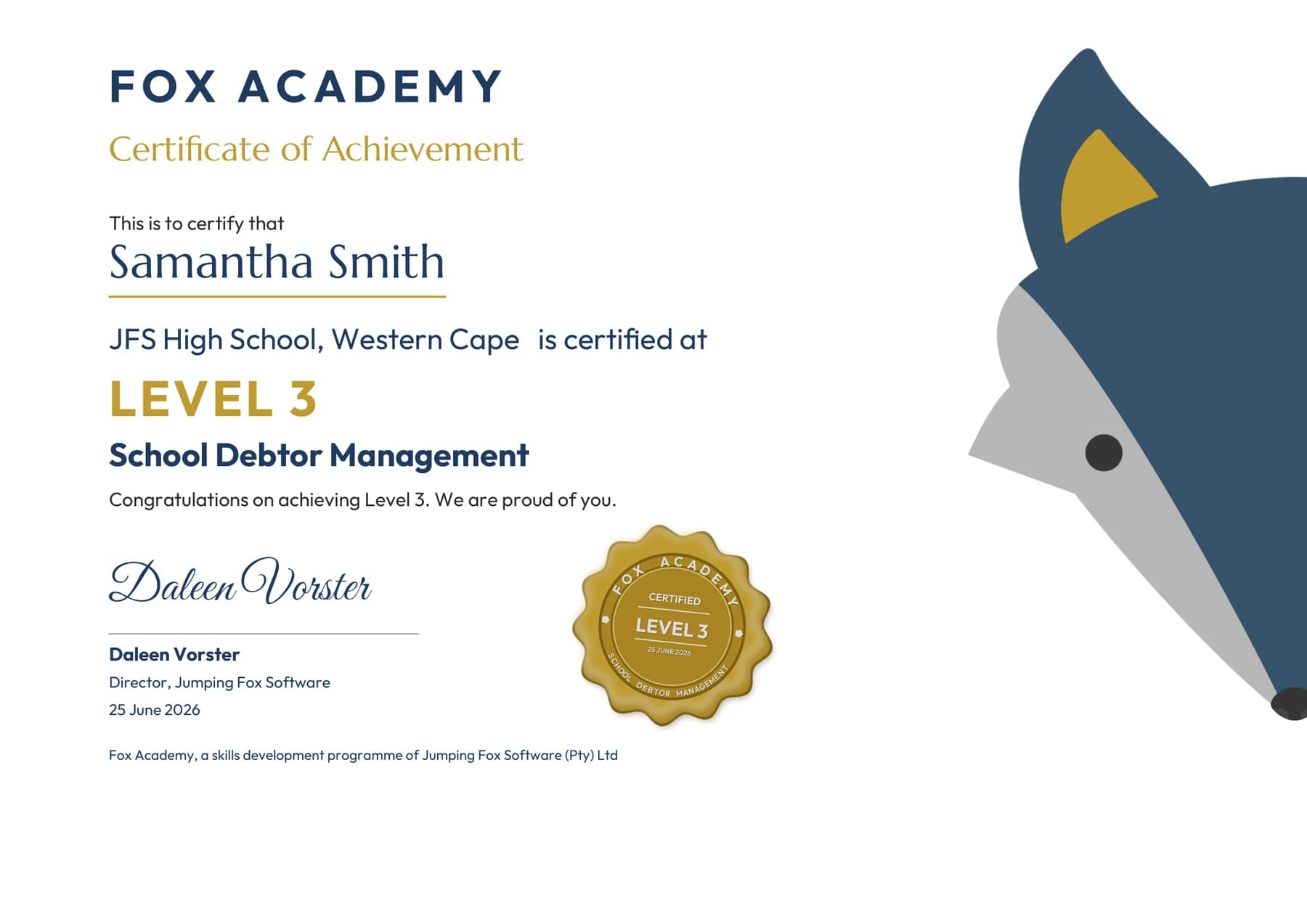
Yours digitally as soon as you pass. Then a printed certificate, signed by both founders, carrying your name and your school's name, posted to your door.
It is in your name and it stays with you. If you move to another school, it moves with you.
85 percent to pass, and Legal and Collections operations carry their own minimum.
The pass mark is high on purpose. A certificate that is easy to get tells a school nothing, and this one is meant to mean something when management sees it. Legal and Collections operations each carry their own minimum of 80 percent as well, so a strong overall score cannot cover a weak area in the two that carry the most risk.
If you do not pass, you rewrite with the next group at R350 excluding VAT for each rewrite. There is no limit on how many times you may rewrite, and your manuals stay yours throughout.
What certification costs, level by level.
Per participant. All prices exclude VAT.
One level a month. A level begins on the first working day of a month, you have that month to work through it, and you write the exam in the first week of the month that follows. All five levels come to 46 hours of work: reading the manuals, doing the activities, the webinar, and a minimum of two hours studying before you write.
Which level are you?
Most people see themselves in more than one. That is normal, because the role was never split up this way before, and almost nobody is doing all of one level and none of the next.
The assessment is free and only takes a few minutes. Nobody is placed at a level by answering the questions in this assessment. It gives us a broad overview of the tasks you already carry and how independently you work, and that is all it does.
A level is earned by working through the manuals for that level, writing the exam, and passing it.